
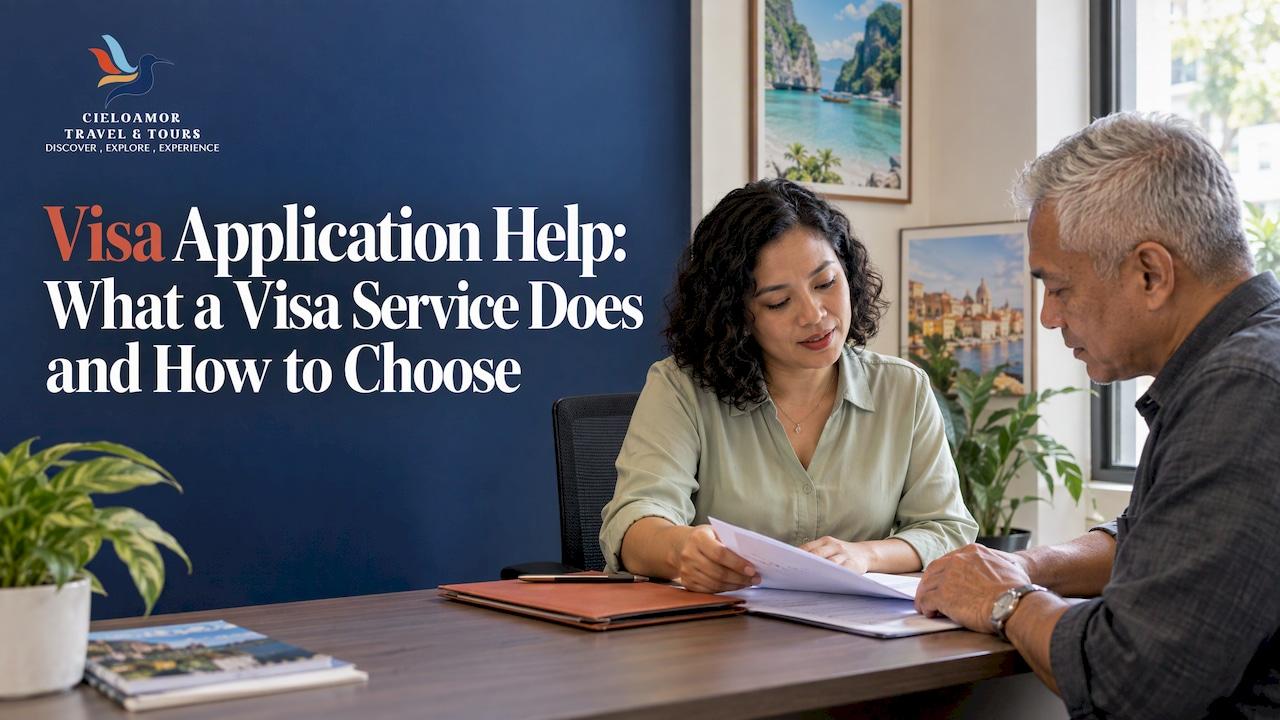
The best visa application help is a real person who checks your documents before you submit, tells you plainly what the consulate requires, and stays reachable if something goes wrong. No agent can promise approval, because the decision belongs to the consulate or immigration authority. What a good service can do is remove the avoidable mistakes: missing papers, inconsistent answers, wrong visa category, missed appointments. That is the help we give at CieloAmor, with in-house agents who answer you from the first inquiry until your return flight.
TL;DR
- Anyone may help you fill in a form in many countries, but advice about your case may be restricted to licensed or exempt people. Always ask who is advising you and under what authority.
- No agent, embassy contact or "insider" can buy you a visa. Be wary of anyone who promises one.
- Most delays and refusals trace back to incomplete, inconsistent or unclear documents. A review before submission is the cheapest fix.
- Processing times differ by country and visa type. Check the official page for the current figure, and wait the official period before chasing.
- For China and Japan visas, our published fees are ₱4,500 to ₱9,000 per person, listed on our visa page.
Table of Contents
- What visa application help actually covers
- Who is allowed to help you with a visa application
- What no one can do: the myth of the inside track
- How to tell legitimate help from a scam
- Step by step: preparing a visa application that holds up
- Visa application delays: what is normal and what to do
- If a visa is refused
- What our visa help costs
- Our perspective
- Bundle the visa with the trip
- FAQ
- Sources
What visa application help actually covers
Visa help comes in three layers, and it pays to know which one you need.
Information. Official websites list the forms, fees, photo rules and document lists. This is the layer the top search results mostly serve: embassy contact tables, form instructions and interview tips.
Preparation. Someone reads your situation, tells you which visa category fits, builds the document set, checks it for gaps and makes sure the story across all papers is consistent. This is where most applicants get stuck, and where a service earns its fee.
Follow-through. Booking the appointment, submitting, tracking status, and responding if the authority asks for more. This is the layer people forget until they are waiting weeks without news.

Our agents work across all three for the destinations we support, and they are people you can message or call, not a ticket queue. If you are also booking flights, hotels or a tour, the same team handles those, so your itinerary and your visa paperwork match.
Who is allowed to help you with a visa application
The rules depend on the destination country, and they are stricter than many travelers expect.
In New Zealand, anyone can help fill in a visa application form, but advice tailored to your case must come from a licensed immigration adviser or an exempt person such as a lawyer. Advice means things like which visa to apply for, which documents you need and how to answer questions. Giving that advice without a licence is an offence there.
Australia works similarly. The Department of Home Affairs states that only a registered migration agent, a legal practitioner or an exempt person can provide immigration assistance, which includes preparing a visa application, advising on a visa matter or representing you before a review body. Australian regulators also describe what registered agents do: they explain options, prepare documents, contact the department and submit applications, and they must keep client money in a separate account, keep records for 7 years and charge fair fees.
The practical lesson: before you hire anyone for immigration-type help, ask what authority they have for the country you are applying to. For tourist visas to destinations that do not regulate advice this way, a travel agency can prepare and submit your documents in line with the consulate's published requirements. For regulated systems like Australia or New Zealand, the legal step belongs to the licensed or exempt person, and that is simply part of the process.

What no one can do: the myth of the inside track
The most expensive mistake in this field is paying for influence. The U.S. Department of State says that an applicant's qualifications and U.S. law are the only basis for visa decisions, and U.S. law prohibits embassy and consulate officials from giving unofficial assistance. Knowing someone at the embassy does not help. The same publication notes that some self-styled facilitators profit by making the process look harder than it is.
Inside the U.S. system, even official advocacy is narrow: advocacy for issuance or special processing by a government official is generally prohibited, with only two named exceptions, the Nonimmigrant Visa Referral Program and the Priority Appointment Request Program.
So what is a legitimate service selling? Not outcomes. It is selling accuracy, speed of preparation, and someone who knows the process and answers your messages.
How to tell legitimate help from a scam
Use this short test before you pay anyone:
- No guarantees. Anyone promising approval, or a "special channel," is describing something the official sources say does not exist.
- Published fees. You should know the service fee and the government or consular fee separately, in writing, before you commit. We publish our visa fees, for example ₱6,500 for a China single entry and ₱4,500 for a Japan tourist visa, on our visa assistance page.
- A real office and real people. A physical address, a business registration or accreditation, and agents you can reach by phone or message. We are a DOT-accredited agency based in Rizal, and you can see how to reach us on our travel agency page.
- You sign your own application. Everything submitted in your name should be information you have read and confirmed as true.
- Your documents stay yours. Passports and originals are handled with a receipt, and you know exactly when and where they go.
Step by step: preparing a visa application that holds up
This is the routine we run through with travelers. Each step shows where applications go wrong.
Step 1: Confirm you need a visa at all
Rules change by passport, purpose and length of stay. Some destinations are visa-free or offer electronic authorizations for certain passports, and others require a full application. Start from the official government or embassy page for your passport. Where it goes wrong: relying on a forum post from two years ago. Our agents check the current requirement for your nationality and destination, so you do not spend money on a visa you do not need, or arrive without one you do.
Step 2: Choose the right category
Tourist, business, transit, family visit and multiple-entry visas have different document lists. Picking the wrong one is a common reason applications stall. For China, for example, we offer single, double and multiple entry options, with the multiple entry fee depending on whether the validity is under or over six months. You can see each option on our China visa assistance page.
Step 3: Build the document set
Immigration New Zealand tells applicants to include all requested information and documents, check whether certified copies, originals or photocopies are needed, and make sure the passport is valid for at least 3 months after intended departure. Other countries set their own validity rules, so read yours carefully. The usual set includes:
- a passport with enough validity and blank pages
- passport photos in the exact size and background required
- proof of funds, employment or business, and ties to home
- a travel itinerary with flights and accommodation
- the completed form, signed where required
Where it goes wrong: a photo in the wrong format, a bank statement that does not match the stated income, or an itinerary that conflicts with the dates on the form. This is where a second pair of eyes matters most. Because we also book flights and hotels, we can line up your itinerary with the visa documents so the dates agree.
Step 4: Check for completeness before submitting
Some governments now build this in. Germany's Federal Foreign Office describes a Consular Services Portal where applicants submit online, get a preliminary completeness check, then book an in-person appointment to give biometrics and pay the fee. Where no such check exists, your agent's review plays that role.
Step 5: Submit, pay and attend the appointment
Book the earliest suitable slot, bring originals, and keep every receipt. Answer interview questions plainly and consistently with your documents. Do not memorize scripts.
Step 6: Track and respond
Keep your reference number safe and check status through the official channel. Respond to any request for more information immediately, since many authorities set a deadline.
Visa application delays: what is normal and what to do
Waiting is part of the process. GOV.UK says UK processing starts once you have submitted the application, given biometrics and provided supporting documents, and that a decision usually takes between 3 and 12 weeks depending on visa type, with settlement applications taking up to 6 months. Other countries publish their own estimates, so look up the current figure on the official page for your destination.
For online systems, there is usually a status tool. The Australian Embassy in Singapore notes that online applicants can check status in ImmiAccount and are notified if an application will take longer than usual.
If your case is under administrative processing, patience is the official advice. The U.S. Embassy in Türkiye says most administrative processing is resolved within 6 months, and applicants should wait at least 6 months after the interview before inquiring, except for emergencies such as serious illness or a death in the immediate family. Check the page for your own country and case type, since the guidance differs.
The best protection against delay is a complete first submission and a travel date that leaves room. Book flexible or refundable arrangements until the visa is in hand. We can help you plan flights and hotels around visa timing.
If a visa is refused
A refusal is not always the end. Start by reading the notice.
In the UK, a refused applicant receives a letter or email explaining why, gets the passport back if it was kept, and learns whether an administrative review or appeal is available. In the U.S., a refusal under section 221(g) means the officer needs more to be satisfied of eligibility, and if more information is requested, the applicant has one year from the refusal date to submit it, or must reapply and pay another fee.
What to do next:
- Read the stated reason and note any deadline in the notice.
- Gather exactly what was requested, nothing more, nothing contradictory.
- If legal remedies such as review or appeal apply, speak to a licensed immigration adviser or lawyer in that country, since that is a legal step.
- Before reapplying, fix the cause. Resubmitting the same file usually produces the same answer.
The common thread in refusals is documents that do not support the stated purpose of travel: unclear funds, a weak itinerary, or mismatched details. Preparing carefully the first time is far cheaper than a second fee.
What our visa help costs
Fees we publish, per person, for applications handled by our agents:
| Visa | Our fee per person |
|---|---|
| China Single Entry | ₱6,500 |
| China Double Entry | ₱7,500 |
| China Multiple Entry (under 6 months) | ₱8,000 |
| China Multiple Entry (over 6 months) | ₱9,000 |
| Japan Tourist Visa | ₱4,500 |
Details and requirements are on our China and Japan visa pages. For current processing times, use the visa page.
Our perspective
Most people come to us after trying the form alone and getting stuck on one question: is my file actually good enough? That is the right question, and it is one a real person can answer in a conversation.
We built CieloAmor around hands-on service. You deal with real humans, from your first inquiry until your return flight. For a visa, that means someone reads your documents with you, tells you what is missing, and stays in touch while you wait.
We also keep the rest of the trip in the same place. Visa, flights, hotel, tour and transfers are handled by one team, so dates and details agree across every document. That is why families, groups and corporate travelers book with us: fewer loose ends, fewer surprises.
We do not promise approvals. We promise attention to your file and a person who picks up.
CieloAmor Marketing
Bundle the visa with the trip
If you are applying for a visa because you are traveling, it makes sense to arrange both together. We offer visa assistance for China and Japan alongside tour packages such as Tokyo Japan 4D3N from ₱22,799 per person and Ho Chi Minh Tour 3D2N from ₱7,599 per person, plus flights, hotels and private van transfers. Browse the tour packages or message our team through our home page to start.

Corporate teams can arrange group travel and visas together through our company outing and corporate travel service.
FAQ
Can an agent help you get a visa?
An agent can help you prepare, check and submit a complete application, and keep you informed while you wait. An agent cannot influence the decision, since the outcome rests on your qualifications and the law. In some countries, advice on your case is limited to licensed or exempt people, so ask about authority first.
How long does a visa application take?
It depends on the country and visa type. The UK, for example, usually decides within 3 to 12 weeks for most visas. Check the official page for your destination, and leave a buffer before booking non-refundable travel.
What should I do if my visa is delayed?
First check your status through the official tool and confirm that biometrics and every document were received. Then wait the period the authority recommends before inquiring. If the notice asks for more information, send it promptly.
Can I speak to a live person about my application?
Government offices have contact tables and phone lines, mostly for form and process questions. With us, you can speak to a real agent from inquiry through your return flight, and we handle the trip bookings that go with the visa.
What can cause a visa refusal?
Common causes are incomplete or inconsistent documents, insufficient proof of funds or ties to home, and a purpose of travel that the file does not support. The refusal notice states the reasons, so read it carefully before reapplying.
Sources
- Getting immigration advice, Immigration New Zealand
- Who can help you with your application? Australian Department of Home Affairs
- Why use a registered migration agent, OMARA
- Straight Facts on U.S. Visas in China, U.S. Department of State
- 9 FAM 601.8, U.S. Department of State
- How to prevent delays with your application, Immigration New Zealand
- Consular Services Portal, German Federal Foreign Office
- Applying online and getting a decision, GOV.UK
- Visa FAQ, Australian Embassy in Singapore
- Administrative Process for Immigrant Visa Applicants, U.S. Embassy in Türkiye
- Administrative Processing Information, U.S. Department of State